Standing in front of your closet before an audition can feel just as nerve-wracking as standing in front of the judges. You pull out a dress, then put it back. You try on a tie, then take it off. Does this look professional enough? Is it too casual? Will I be able to hit that high note without popping a button?
If you’re obsessing over your outfit, take a deep breath. You aren't alone. Every singer, from Broadway veterans to first-time auditioners, has faced the "what do I wear?" dilemma.
The good news is that your clothing is a tool that can actually help you perform better. The right outfit doesn't just make you look the part; it helps you feel the part. It supports your breath, grounds your posture, and gives you that extra boost of confidence when you walk into the room.
Whether you are preparing for a local choir tryout, a musical theatre casting, or a college conservatory interview, this guide will help you navigate the do’s and don’ts of audition attire so you can focus on what really matters: your voice.
The Golden Rule: Comfort Equals Confidence
If there is one piece of advice you take away from this guide, let it be this: Comfort is key.
When we talk about comfort in a singing context, we aren't talking about sweatpants and oversized hoodies. We mean "functional comfort." Singing is a physical activity. Your body is your instrument, and your clothing is the case it lives in. If the case is too tight, the instrument can't resonate.
Why Fit Matters for Breathing
Your diaphragm needs room to expand. When you take a deep breath for that powerful opening phrase, your ribcage expands, your stomach moves outward, and your back muscles engage.
If you are wearing high-waisted jeans that dig into your stomach or a dress with a rigid bodice that restricts your ribcage, you are physically fighting your clothes to get a good breath. This adds unnecessary tension to your body, which travels straight up to your throat and affects your tone.
The "Deep Breath" Test:
Before you commit to an outfit, put it on and stand in front of a mirror. Take the deepest breath you can.
- Does the waistband cut into you?
- Do the shoulders restrict your movement?
- Can you expand your lower back and ribs fully?
If the answer to any of those is "no," change the outfit. You want clothes that move with you, not against you.
Posture and Grounding
Your clothing also affects how you stand. Shoes that pinch your toes or heels that are too high can throw off your center of gravity. When your balance is off, your body compensates by tightening other muscles—often in the neck and jaw—to keep you upright.
"The best singer stance for developing your vocal range is standing straight with knees unlocked and your feet placed shoulder-width apart," says our internal coaching guide. Your outfit should encourage this grounded, neutral posture.
Understanding the "Uniform": Casual vs. Formal
One of the biggest sources of confusion is that "audition attire" changes depending on the genre. What works for a rock musical won't work for a classical conservatory. Here is how to navigate the different expectations.
1. Musical Theatre and Pop Auditions
For most modern auditions, the vibe is "polished casual" or "smart casual." You want to look like a professional version of yourself.
For Women:
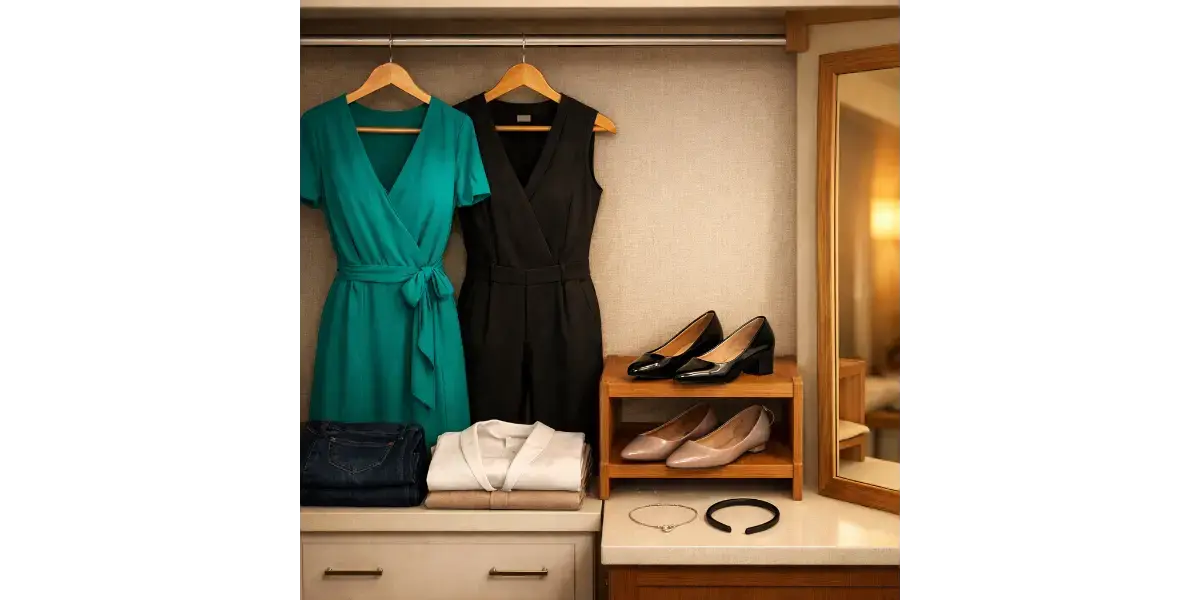
- The Go-To: A wrap dress or a jumpsuit is often a winner. It is flattering, allows for deep breathing, and looks put-together without being stiff.
- Separates: A nice blouse with dark jeans or trousers is perfectly acceptable.
- The "Blazer Test": Ask yourself, "Could I wear this to a creative job interview?" If the answer is yes, you are on the right track.
For Men:
- The Go-To: Dark denim or chinos paired with a button-down shirt or a high-quality polo.
- Layers: A light jacket or an open button-down over a t-shirt can look stylish, but make sure it doesn't look sloppy.
- The "Tie Test": Look in the mirror. Could you add a tie and walk into a corporate office? If yes, great. (But leave the actual tie at home for pop/rock auditions—it’s usually too stuffy!).
The Goal: You want the casting director to be able to imagine you in the role. You don't need to wear a costume (please don't wear a costume!), but you can hint at the character. If you are auditioning for a rugged rock musical, a leather jacket is fine. If it’s a golden-age classic, lean towards cleaner lines and brighter colors.
2. Classical, Choir, and Conservatory Auditions
The rules tighten up a bit here. Tradition plays a larger role in classical music, and showing respect for the adjudication panel is paramount.
The Standard:
Think "Sunday Best" or "Business Professional." You are showing the panel that you take this opportunity seriously.
- For Women: A knee-length dress or a skirt with a nice blouse is standard. Pantsuits are also increasingly common and acceptable, especially if they allow for better grounding. Avoid floor-length ball gowns—this is an audition, not a gala.
- For Men: Slacks and a button-down shirt are required. A blazer is a nice touch. A tie is often expected for very formal conservatory auditions, but check the specific requirements of the school or choir first.
What to Avoid:
- Jeans (even black ones).
- Sneakers.
- Short skirts (anything significantly above the knee can be distracting when you are on an elevated stage).
Footwear: The Foundation of Your Performance
We cannot stress this enough: Your shoes are the most important part of your outfit.
As a singer, your power comes from the floor. You push against the ground to generate support. If your feet hurt, or if you are wobbling, your voice will suffer.
For Women
There is a myth that you must wear heels to an audition. This is false. If you are comfortable walking and singing in heels, go for it—they can help with posture. However, if you rarely wear heels, an audition is not the time to start.
- The Safe Bet: A low block heel or a supportive bootie. These give you a bit of height and style but offer a wide base for stability.
- Flats: Stylish flats or loafers are completely acceptable, especially if you are taller or simply prefer to be grounded.
- Avoid: Stilettos (too wobbly), flip-flops (too casual), or brand-new shoes you haven't broken in yet.
For Men
- The Safe Bet: A clean dress shoe, loafer, or a very clean, solid-colored boot.
- Avoid: Athletic running shoes, dirty sneakers, or sandals.
Grooming and Accessories: The Finishing Touches
You want the panel to remember your voice, not your bangle bracelets clanking together every time you move your arm.
Jewelry and Accessories
Keep it simple. You want your face to be the focal point.
- Avoid Noisy Jewelry: Long necklaces that hit your belt buckle or stacks of bracelets that jingle can be an auditory distraction.
- Watch the Hair: If you have long hair, your default should be to keep it out of your face. You communicate so much emotion with your eyes and eyebrows; don't hide them behind bangs.
Makeup and Styling
Aim for a look that makes you feel fresh and awake. Stage lighting can wash you out, so a little extra definition on the eyes or lips can be helpful, but avoid heavy "stage makeup." You want to look like a human being, not a mannequin.
4 Common Mistakes to Avoid
Even with the best intentions, singers often fall into these common traps.
1. The "Black Hole" Effect
Wearing head-to-toe black is safe, but it can also be forgettable. You don't need to wear neon yellow, but a pop of color—a jewel-tone shirt, a colored scarf, or a bright tie—can help the judges remember you. "The girl in the teal dress" is easier to recall than "the fifth girl in black pants."
2. The "Fidget" Factor
Does your strap keep falling down? Do you have to keep pulling up your pants? If you have to adjust your clothing even once during a song, it breaks the spell of your performance. Do a "jiggle check" at home. Jump up and down, wave your arms, bow. If everything stays in place, you’re good to go.
3. Showing Too Much Skin
This isn't about modesty; it's about focus. Human eyes are naturally drawn to skin. If you are wearing a very low-cut top or a very short skirt, the panel's eyes might drift away from your face. You want 100% of their attention on your expressions and your vocal delivery.
4. Ignoring the Temperature
Audition holding rooms are notoriously unpredictable. They are either freezing cold or boiling hot. Always dress in layers. A nice cardigan or blazer that you can take off just before you sing is a lifesaver.
Checklist: The "Ready to Sing" Mirror Test
Before you head out the door, stand in front of the mirror and run through this final checklist.
- Can I breathe deeply? (Check the waistband).
- Can I move my arms? (Check the shoulders/sleeves).
- Do I feel grounded? (Check the shoes).
- Is my hair out of my face?
- Do I feel like me?
That last point is crucial. "The key to singing with confidence is finding your own voice and not mimicking anyone," and the same goes for your style. If you feel like you are wearing a costume, you will sing like you are wearing a mask. Wear something that makes you feel powerful, authentic, and ready to share your gift.
Confidence Comes From Preparation
At the end of the day, the best thing you can wear is confidence. A confident voice rings true. It doesn't need to overreach or undershoot.
Choosing the right outfit is just one part of the preparation puzzle. The other part is knowing that your voice is ready to handle whatever the audition throws at you. Whether you are working on your breath support, expanding your range, or just trying to work up the nerve to sing in front of others, having a guide makes all the difference.
If you are ready to take your singing to the next level—and ensure your voice sounds as good as you look—we are here to help.
Go to VoiceLessons.com to arrange a trial lesson today. We’re here to help you develop a plan and encourage you to meet your singing goals. The first note starts here.


.webp)