Establishing Basics for Singing Success
Establishing basics for singing success may seem more foreign than learning a new language for any beginner. Learning to sing involves hearing the right things, using parts of the body that you need to be a doctor to find, and then emitting sounds that might seem like you need to have the muscle control of an Olympic gymnast.
Tired yet? Don’t be discouraged. Singing lessons help thousands of people become better singers. They can take you through the steps in easy-to-manage stages too. Good voice lessons and smart vocal coaches help neophyte singers build the basics of understanding vocal production anatomy designed for singing success.
Can Everyone Sing?
The answer is a resounding, “Yes!” Unless, of course, you are looking for an excuse to get out of Friday night open mic nights with your co-workers. We’re not going to judge; we’re here to help those wanting help and are serious about learning.
Vocal experts agree: If a person can speak, they can learn to sing. This doesn’t mean you’ll hit notes with Frank Sinatra’s suave demeanor. But learning to hold notes and move through progressions of scale in songs is entirely possible.
It’s self-judgment that is the real problem when anyone new to singing is developing vocal chops. Think of it this way: how many people do you know love how their voice sounds on their voicemail? The reality is that most people hate the sound of their own voice and want to learn to sound like their favorite star. That is what sets people up for disappointment. But if you listen to your favorite country or pop stars, you will hear variations in voice quality, meaning some people simply have more nasally sounds while others sound more gritty. These aren’t things that can always be controlled, at least without potentially damaging your vocal cords.
For those who have the goal of learning to sing, singing lessons will help. If the goal is to mimic the amazing vocal abilities of Adele, the probability is disappointment. Just like coaching cannot make us all Babe Ruth batters, not everyone has the natural abilities of some of the greatest. But if expectations are adjusted to more realistic standards, finding your own voice is absolutely possible.
Singing Physiology: Where is Your Diaphragm?
Everyone says to sing from my diaphragm. It’s true; every singer just like any athlete needs to start with solid fundamentals. Fundamentals start with the physiology involved in singing.
Building singing basics means building your singing body. This doesn’t mean you need to spend hours in the gym every day. It means you need to understand the parts of your body that create sound and how those parts need to work when you’re singing. We’ll start with the diaphragm since it gets the most publicity — yep, the diaphragm is often considered the Taylor Swift of your singing physiology. The diaphragm is a muscle located just below the lungs above the navel. It is the key muscle for respiration, pulling air into and expelling it from your lungs in an unconscious rhythm.
TRUE OR FALSE: The diaphragm can be controlled with exercise.
False. Don’t let that deflate your diaphragm because you still need it. But somewhere in the history of vocal instruction a myth has been propagated. We feel compelled to set the record straight. The diaphragm functions as part of the autonomic nervous system – it works automatically and can’t be controlled by singing exercises.
Without going into a full-blown anatomy lesson, here is the basic flow for sound production:
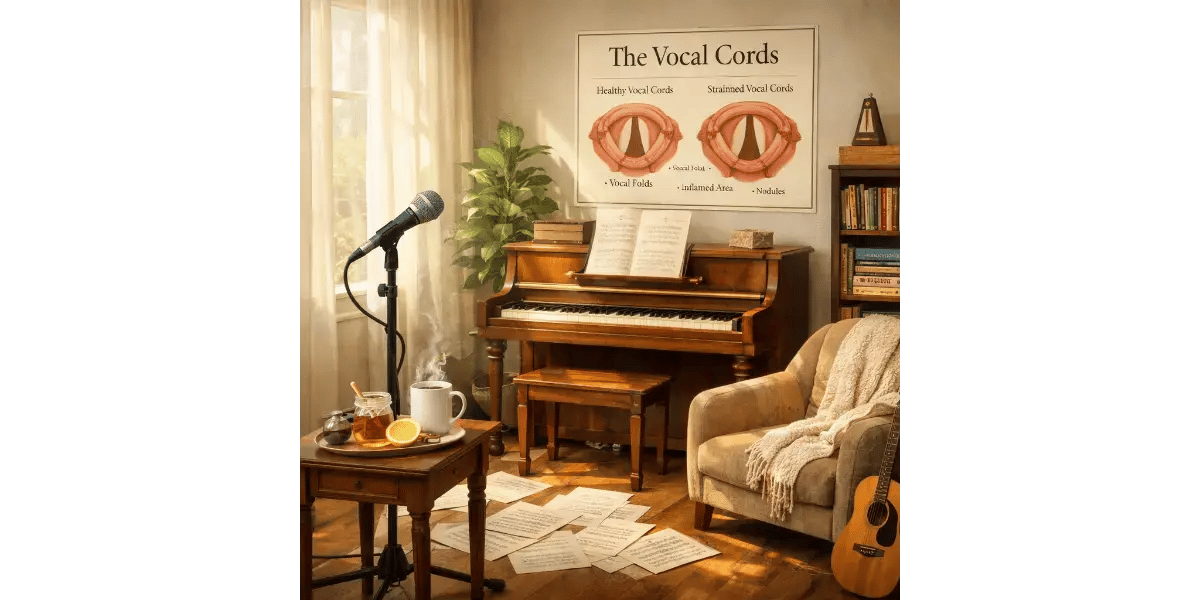
Sounds are created when air is pushed up from the lungs up through the trachea, the vocal cords and past the larynx, pharynx up across the soft palate and out of the mouth. The larynx is also called the voice box. No controlled sound occurs unless the muscles surrounding the cords control vocal folds. As vocal folds open and close, the cords vibrate to create sounds contingent on how taut the cords are and how much pressure is exerted. This is why you need breath support, or as we like to call it, Breath Management.
What do I do with each of these parts?
- First, learn to control airflow. This isn’t accomplished by trying to control the diaphragm. Instead, learn deep belly breathing techniques. Stand tall and take a deep breath. Control the breath in and then slowly exhale. Repeat this to develop muscle control just like you would perform a bicep curl; slowly and smoothly to build muscle control.
- Consider the smaller neck muscles. Now that you can push air up through your body with control, consider the smaller neck muscles and components that help you make sounds and sing in perfect pitch. Vocal cords vibrate when air flows across them and are moved by intrinsic muscles in the neck. Extrinsic muscles control the position of the larynx and neck posture. These are small muscles that don’t get stronger the way your quadriceps do with squats. There are exercises to help train these muscles.
Glottal Stop Exercise
This is an anatomical name for a simple exercise you actually do every time you cough. Take a breath, push the air out from the belly and then close the throat. You don’t need to cough in the exercise. Instead, place your tongue along the soft palate to make the sound /t/ preventing air from escaping. Release and repeat.
A vocal coach is the best person to work with you as you build basic skills of muscle control. Once you master this basic skill, vocal coaches will notch it up with other exercises. Keep in mind that any type of exercise done for extended periods leads to fatigue. Listen to your body when tired.
If you are consistently hitting a specific note through your vocal exercises practice, your singing teacher will also work with you to hear different notes expanding your range. Learning to recognize and then repeat notes develops pitch. Body mastery leads to vocal mastery where you can experience singing success.
Can You Get Better at Singing with Practice?
If you take a music lesson from a vocal coach, you will learn something whether you are a beginner or a pro. You might not even need 10 lessons to absorb information and learn techniques to then be able to practice what was learned in the voice lesson. But if you don’t practice after the lesson, you will never improve singing ability. Regular music lessons with a singing teacher helping you develop tools for vocal range is the best way to improve as a singer.
Any technique learned needs to be practiced just like a tennis stroke needs to be practiced. Singing lessons, including doing vocal exercises via online singing lessons, not only reinforces lessons, but also develops confidence as you build new skills.
Act like a pro when learning to sing.
That isn’t suggesting auditioning for the next American Idol copycat talent show. But if you really want to learn to sing, you need to make a commitment to voice practice. Schedule singing lessons as time and financial resources allow. Most people can’t afford daily singing lessons so you’ll need to establish practice sessions daily. Incorporate online voice lesson tools and set a time every day to practice.
Devote that time, even if it is just five minutes; commit to warming up with stretches and breathing exercises. Maintain good posture and try to practice when you will be uninterrupted. Of course, voice teachers would love for you to practice for a full 30 minutes or longer. But if you can only practice properly for five to 10 minutes, it’s better to practice properly rather than practice for extended periods of time tired.
How Long Does it Take to Learn How to Sing?
This might not be what you want to hear, but we’ll say it anyway: how long does it take to learn to sing is the wrong question. Anyone can learn the basics of singing in a lesson or two. The question should be: how long does it take to develop vocal mastery.
The answer to that is a bit more complicated. After all, everyone starts with a different level of skill, genetic gifts and disposition for practice discipline. The reality is mastering singing is a lifelong endeavor that even professional singers continually work at.
It is completely understandable to want to quantify this though. It takes time and costs money to pay for voice lessons. Having reasonable expectations for your growth and your coach’s ability to convey ideas to you is important.
The best way to approach how long it will take to learn to sing is to meet with a voice coach and discuss your baseline starting point. Go over your goals and then establish realistic timeframes for growth. Break goals down into smaller goals.
For example, the end-goal might be to perform a popular pop song. There is nothing wrong with that, but break that down into smaller accomplishments with shorter time frames:
- You might start with Twinkle Twinkle Little Star in a three-week period.
- Perhaps there are tone, pitch or vocal power goals you want to meet as well.
Not only does breaking the bigger goal down into smaller goals make progress easier to measure, it helps you build confidence in your growing abilities. Develop the plan. Set a calendar with achievable goals. Commit to a regular practice schedule and then measure success. The more commitment you have, the faster your learning curve in learning to sing will be.
Working With Your Vocal Coach
The purpose of a coach is to help you build basic skills and fine-tune more advanced abilities in singing techniques. You will learn to sing faster and with better habits when you have proper vocal coaching just like a person new to tennis will improve faster with a tennis coach.
Singing coaches are there to help you learn how to use your body to create sounds that match tone, pitch and tempo of your favorite tunes. They also teach you how to warm up and cool down after a singing workout. These skills help you prevent vocal injury, which removes you from being able to practice singing.
When you aren’t with your coach during a private lesson, make sure you are practicing with intention and using resources that help you. Online lessons such as those found at VoiceLessons.com are designed to walk you through step-by-step practice routines. These are great supplements to working with vocal coaches or a way to develop your skills in a professional manner without trying to coordinate schedules and leaving the house.