Build Breath Support with Diaphragmatic Breathing for Confident Singing
Imagine sustaining long notes with ease, singing freely, and not running out of breath mid-phrase. This is possible when you understand how your voice works.
You can begin improving your singing by learning how your body naturally supports sound.
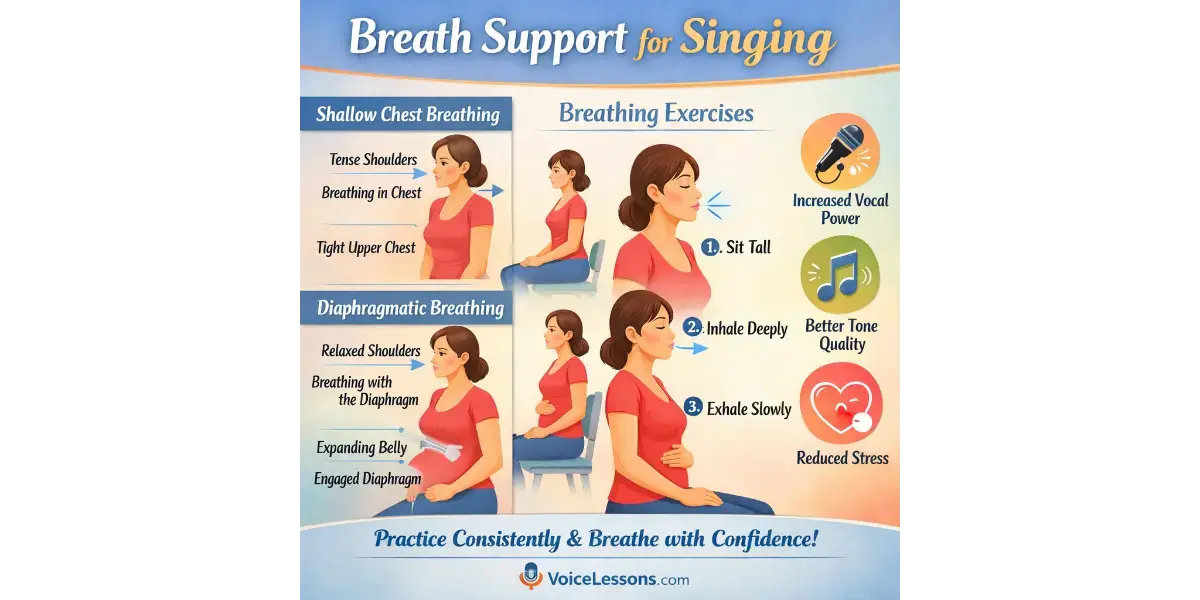
Developing your voice involves coordination between your vocal muscles and your breathing system. Breath support is essential for strong, controlled singing. Many beginners rely on shallow breathing from the chest and shoulders, which creates tension and limits vocal power. Even simple songs can feel tiring.
Learning diaphragmatic breathing can transform your voice. This technique allows you to breathe deeply and rely on your breathing muscles to support your sound. Breath support is not about forcing or holding your breath. It is about creating steady airflow that allows your voice to move freely and expressively.
Your voice has potential. To unlock it, you need consistent airflow and proper breathing technique. With practice, your lungs can work more efficiently and support your vocal performance.
Why Breath Support Matters for Singing
Healthy vocal function depends on steady airflow. Without proper breath support, your voice may feel weak or unstable.
Many beginners struggle with shallow breathing, which creates tension and reduces control. Diaphragmatic breathing helps your lungs expand fully and improves oxygen flow.
This leads to several benefits:
- Increased vocal power without strain
- More stable pitch through steady airflow
- Improved tone quality with deeper breathing
- Better vocal stamina for longer phrases
- Reduced tension in the neck and shoulders
When your breathing improves, your overall singing becomes more consistent and controlled.
For additional breathing techniques and exercises, explore our breathing exercises for singing guide.
What is Diaphragmatic Breathing?
The diaphragm is a muscle located beneath your lungs. It plays a key role in breathing and vocal support.
Shallow breathing limits your lung capacity and often creates tension. Diaphragmatic breathing allows your lungs to expand fully, providing better airflow and control.
How it works:
- Inhale slowly through your nose and allow your abdomen to expand
- Keep your chest relatively still
- Exhale slowly through your mouth with relaxed lips
How to feel it:
- Lie down with your knees bent
- Place one hand on your chest and one on your abdomen
- Inhale and feel your abdomen rise
- Exhale and feel it fall naturally
Practicing this for a few minutes daily helps build awareness and control.
5 Breathing Exercises for Singing
Practice these exercises for five to ten minutes before singing.
1. Abdomen Breathing
Purpose: Build awareness and reduce tension.
- Sit upright with relaxed shoulders
- Place your hand on your abdomen
- Inhale for four counts and feel expansion
- Hold briefly without tension
- Exhale slowly for four counts
This helps develop steady airflow and improves control.
2. Sustained “S” Sound
Purpose: Train steady airflow.
- Take a deep diaphragmatic breath
- Release air on a continuous “sss” sound
- Keep the sound smooth and consistent
- Gradually increase duration
This improves breath control and vocal stability.
3. Counting Breaths
Purpose: Increase lung capacity.
- Inhale for four counts
- Exhale on “sss” for eight counts
- Gradually extend to longer counts
This builds endurance and helps maintain pitch.
4. Pulsed Breathing
Purpose: Improve rhythm and control.
- Take a deep breath
- Start a steady “sss” sound
- Add short pulses in rhythm
This helps with timing and articulation in singing.
5. 360-Degree Breathing
Purpose: Develop full breath support.
- Sit upright and place hands on your abdomen and ribs
- Inhale and feel expansion in your sides and back
- Exhale slowly
This encourages full-body breathing and better support.
Apply Breath Support to Singing
To connect these exercises to real singing:
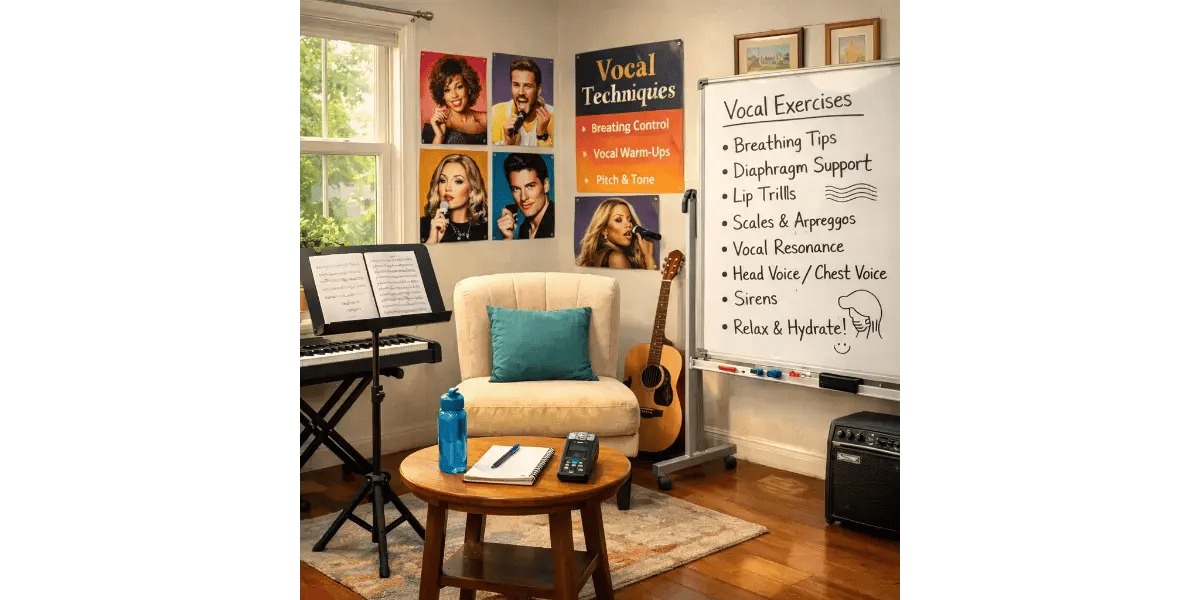
- Practice lip trills while focusing on steady airflow
- Sing scales using controlled breathing
- Pause and reset your breath if needed
- Practice short phrases with consistent breathing patterns
These steps help you apply technique directly to songs.
You can also incorporate vocal warm-up exercises into your routine to prepare your voice before practicing.
Common Breathing Mistakes & Fixes
Mistake: Shoulders rising
Fix: Return to upper abdomen breathing
Mistake: Neck/jaw tension
Fix: Relax shoulders; reset posture
Mistake: Gasping
Fix: Inhale slowly through your nose, mouth closed
Mistake: Dizziness
Fix: Slow tempo, breathe in gently, exhale fully
Tip: Mistakes are normal, they show growing awareness of singing breath support.
Progress Tracking & Motivation
Use this checklist to visualize improvement:
Exercise: Sustained “SSS” Hiss
Goal: 30 sec+
Current: ______
Notes: Track weekly progress
Exercise: Hiss with Pulses
Goal: 20 pulses
Current: ______
Notes: Improve timing accuracy
Exercise: 360-Degree Breath
Goal: Full expansion
Current: ______
Notes: Feel expansion in sides/back
Exercise: Abdomen Breathing
Goal: 8–10 deep breaths
Current: ______
Notes: Monitor steady airflow
Exercise: Song Phrases
Goal: Sing without running out of air
Current: ______
Notes: Apply in real songs
Refine your breath support for singing. Book a session with VoiceLessons.com and unlock your full vocal potential. Confidence in your breathing and airflow becomes confidence in your sound - one breath at a time. For more tips to improve your singing voice, check out our guide to improving your singing voice.
Join Free Voice Lesson
Ready to improve your breathing, vocal control, and singing confidence? Join Free Voice Lesson and take the next step in your singing journey.