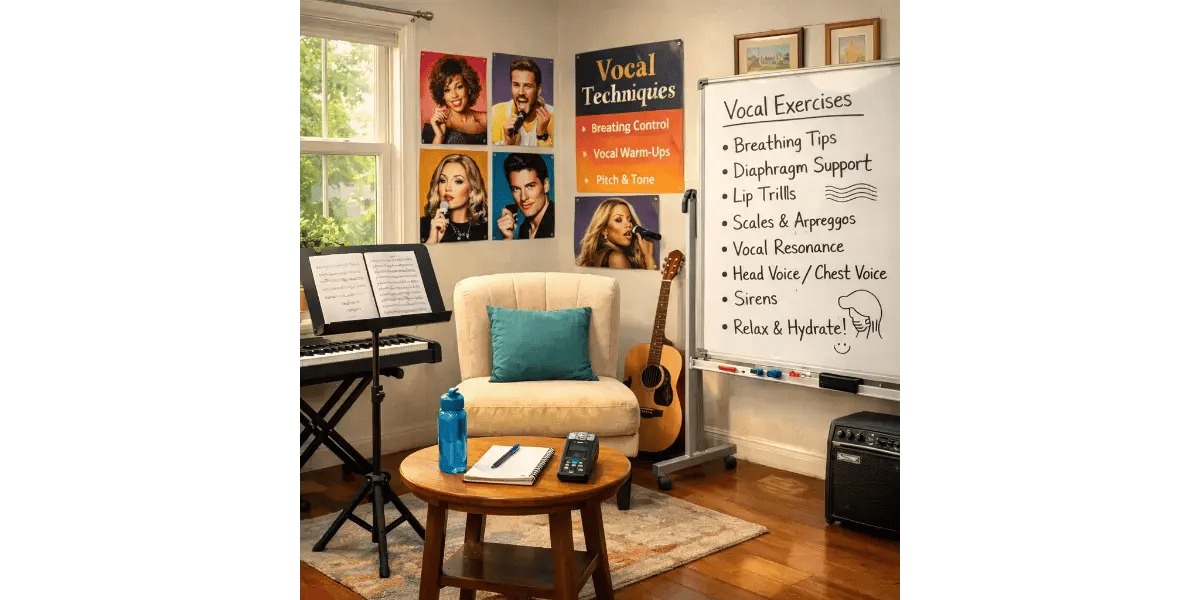
Easy and Safe Exercises to Build Power, Control, and Confidence
Have you ever wanted your voice to sound stronger, clearer, or more controlled? Many beginners believe great singers are born with natural talent, but the truth is different.
Your voice is an instrument, and like any instrument, it can be trained, strengthened, and refined.
In this guide, you will learn how to strengthen your singing voice using simple exercises, proper breathing habits, and safe techniques that help you build vocal power without strain. You will also find practical tips and a clear routine to help you improve with consistency.
Quick Reference: Beginner Singing Exercises
Here are the most effective beginner singing exercises to help you build vocal strength, improve control, and develop better pitch accuracy.
| Exercise |
Purpose / Benefit |
Duration |
| Diaphragmatic Breathing |
Improves breath support and vocal power for stronger singing |
3–5 min |
| Lip Trills |
Builds vocal control and reduces tension in the voice |
2–3 min |
| Humming Warm-Up |
Improves resonance and tone quality |
2–3 min |
| Sirens / Slides |
Helps smooth transitions between vocal ranges |
2–3 min |
| NG-AH Exercises |
Strengthens resonance and improves vowel clarity |
2–3 min |
| Solfege Scales |
Improves pitch accuracy and expands vocal range |
3–5 min |
Understanding Your Voice
Your voice works through three main components:
Breath Support
Your lungs and diaphragm provide airflow that powers your voice.
For more guidance, see these breathing exercises for singing.
Vocal Cords
These muscles vibrate and adjust to create sound.
Resonance
Your throat, mouth, and sinus spaces shape tone and amplify sound.
To strengthen your singing voice, these parts must work together efficiently.
Step 1: Improve Breath Support
Breath support is the foundation of a strong voice. Many beginners rely on throat tension instead of proper airflow.
How to practice
- Sit or stand upright with relaxed shoulders
- Place one hand on your abdomen and one on your chest
- Inhale through your nose and let your abdomen expand
- Exhale slowly on a steady “sss” sound
Quick check
If your abdomen moves more than your chest, you are using proper breathing.
Step 2: Core Singing Exercises for Strength
Strength comes from doing small, consistent vocal warm-ups, not pushing or forcing sound. Start with these safe singing exercises for beginners.
Exercise 1: Lip Trills
Lip trills help regulate airflow and reduce tension.
How to do it
- Gently close your lips and blow air to create a vibration
- Sustain a note, then move into slides
You are doing it correctly when the sound feels steady and relaxed.
For more warm-up ideas, explore these vocal warm-up exercises.
Exercise 2: Humming Exercise
Humming improves resonance and tone.
How to do it
- Keep your lips lightly closed
- Focus on vibration around your nose and lips
- Sing simple scales
You should feel a consistent vibration in the front of your face.
Exercise 3: Sirens
Sirens connect your low and high range.
How to do it
- Start on a low pitch
- Slide smoothly to a higher pitch and back down
- Keep your jaw relaxed
Smooth movement means your voice is becoming more connected.
Exercise 4: NG-AH Exercise
This exercise builds resonance and vowel control.
How to do it
- Sustain the “ng” sound
- Open into an “ah” vowel
- Practice scales while maintaining both vibration and space
This helps balance resonance and clarity.
Exercise 5: Solfege Scales
These improve pitch accuracy and range.
How to do it
- Sing Do, Re, Mi and continue through the scale
- Keep your tone steady and consistent
You should be able to move between notes smoothly.
Building Vocal Strength and Stamina
Stay Hydrated
Drink water regularly to keep your voice functioning well.
Warm Up and Cool Down
Start with gentle exercises and finish with light humming to relax your voice.
Practice Consistently
Practice for 15 to 30 minutes daily. Consistency builds strength over time.
Rest When Needed
If your voice feels tired or strained, allow it to recover.
Avoid Vocal Strain
Limit shouting, whispering, and speaking over loud environments.
Frequently Asked Questions
How can I strengthen my singing voice at home?
Practice breathing exercises, use simple warm-ups like lip trills and humming, and stay consistent with daily practice.
What are safe singing exercises for beginners?
Lip trills, humming, NG-AH exercises, and light scales are effective and reduce tension.
How long does it take to build vocal strength?
Most beginners notice improvement within a few weeks, with stronger results over time.
Can I improve without a vocal coach?
Yes, but guidance helps you avoid mistakes and progress faster.
Final Thoughts
A strong singing voice is developed through consistent practice and proper technique. By focusing on breathing, coordination, and simple exercises, you can build control and confidence over time.
Ready to Improve Your Singing
If you want faster progress and personalized feedback, working with a vocal coach can help.
Start here: Book a session with a vocal coach.
Join Free Voice Lesson
Ready to build a stronger, more controlled singing voice? Join Free Voice Lesson and take the next step in your singing journey.